


Zhejiang Yuan Ding Marine Equipment Co., Ltd., with over two decades of dedicated history, has been singularly focused on one thing: crafting high-quality marine propellers. Since our inception, we have been committed to delivering exceptional Fixed Pitch Propellers (FPP) and Controllable Pitch Propellers (CPP) to meet the diverse needs of our global clientele.


Product Categories



Why Choose Us
Our Factory
With a team of 130 dedicated professionals, our 16,000 square meter workshop annually produces 2,000 tons of copper alloy propellers, committed to providing efficient and reliable marine propulsion solutions.
Custom Service
With our advanced casting process, Yuan Ding Marine delivers fully customized propellers, whether you need one unique design or consistent quality across a large batch.
24/7 Customer Support
Our round-the-clock customer support ensures quick responses to inquiries, from initial consultations to after-sales services. We're here whenever you need us.
Advantages of Oil Tanker Propeller

High-Thrust Performance for Heavy Loads
Designed to handle the immense weight of fully-loaded oil tankers, the Tanker Ship Propeller provides superior thrust and stability, ensuring smooth and reliable operation under extreme conditions.

Optimized for Fuel Efficiency
With advanced blade geometry, the propeller minimizes drag and maximizes thrust, reducing fuel consumption over long-haul routes. This translates into significant cost savings and lower emissions for environmentally responsible operations.

Enhanced Maneuverability
Engineered to improve vessel control, the Tanker Ship Propeller offers better maneuverability during docking, loading, and unloading operations. This ensures safer handling in ports and narrow channels.
Specification of Oil Tanker Propeller
|
Diameter |
6.2M |
|
Weight |
18Tons |
|
Materical |
Ni-Al Bronze(Cu3) |
|
Size and diameter |
The propeller size has to align with the vessel's size and engine power. For instance, larger vessels require more powerful engines and, consequently, larger marine propellers. The diameter of the propellers can range from 0.3 to 10m for small vessels and up to 9m for large ocean-going vessels. |
|
Number of blades |
Propellers can have 3 to 6 blades, although those with 4 blades are the most common. Typically, the number of blades is determined by the desired efficiency and the required thrust. |
|
Blade shape and material |
Large marine propellers have different blade shapes depending on the purpose. For example, vessels designed for speed have propellers with blades that reduce drag. The propeller material also influences durability and maintenance. Blades are mostly made from steel, bronze, and aluminum. |
|
Pitch |
Pitch is one of the most important specifications when it comes to large marine propeller maintenance. It refers to the distance a propeller would move forward in one rotation if it were placed in a soft solid. A propeller with a high pitch provides more speed, but the engine has to work harder, affecting fuel efficiency. As such, there is a trade-off between speed and thrust. |
|
Engine power and rotation speed |
The large ship propeller must be compatible with the vessel's engine power. Propellers for large vessels range from hundreds to thousands of horsepower. Additionally, the rotation speed of the propeller is specified in revolutions per minute (RPM). |

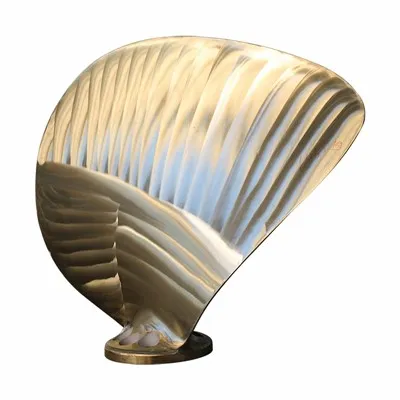
The propeller is composed of several blades. The number of blades is usually three blades, four blades or five blades, and the angles between the blades are equal. Usually installed at the stern of the ship, the connecting part between the propeller and the stern shaft is called the hub, and the blades are fixed on the hub. When looking at the bow from the stern, the side of the blade seen is called the leaf surface and the back of the blade. The outer end of the blade is the tip, and the connection with the hub is called the root. The circular trajectory of the blade tip during rotation is the tip circle. This circle is called the paddle disk, the diameter is called the diameter, and its area is called the disk area.
The size of the propeller diameter is often limited by the ship's draft. The larger the diameter, the lower the speed and the higher the efficiency. There must be a good fit with the stern frame of the ship to prevent the tip of the blade from coming out of the water and affecting efficiency. The hull clearance should be appropriate to avoid causing severe vibration. When the forward car rotates, if the direction of rotation seen from the stern to the bow is clockwise, it is called a right-handed propeller, otherwise it is a left-handed propeller. The two-oar boat is installed on both sides of the stern. When it rotates normally, if it rotates toward the center line of the ship, it is called an internal propeller, otherwise it is an external propeller.
FAQ
We're professional oil tanker propeller manufacturers and suppliers in China. If you're going to buy high quality oil tanker propeller, welcome to get quotation from our factory. Also, custom service is available.
oil tanker propeller, 4 M Propeller for Oil Tanker, Tanker Ship Propeller