


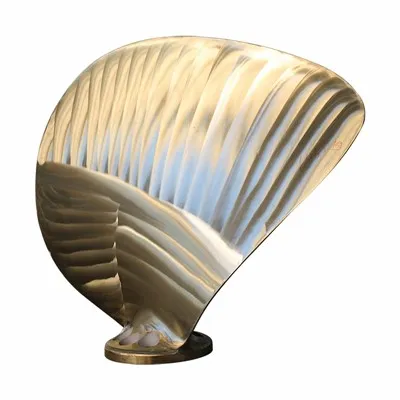
Bulk Carrier Propeller
Zhejiang Yuan Ding Marine Equipment Co., Ltd., with over two decades of dedicated history, has been singularly focused on one thing: crafting high-quality marine propellers. Since our inception, we have been committed to delivering exceptional Fixed Pitch Propellers (FPP) and Controllable Pitch Propellers (CPP) to meet the diverse needs of our global clientele.


Product Categories



Why Choose Us
Our Factory
With a team of 130 dedicated professionals, our 16,000 square meter workshop annually produces 2,000 tons of copper alloy propellers, committed to providing efficient and reliable marine propulsion solutions.
Custom Service
With our advanced casting process, Yuan Ding Marine delivers fully customized propellers, whether you need one unique design or consistent quality across a large batch.
24/7 Customer Support
Our round-the-clock customer support ensures quick responses to inquiries, from initial consultations to after-sales services. We're here whenever you need us.
Features of Bulk Carrier Propeller
Propulsion
The primary function is to convert the engine's rotational energy into thrust, propelling the ship forward or backward effectively.
Manoeuvrability
Especially in controllable pitch designs, cargo ship propellers allow for improved maneuverability in tight docking conditions, which is vital in busy ports.
Efficiency
Advanced designs and materials contribute to better fuel efficiency and reduced operational costs, aiding in the dynamic economics of cargo transport.
Durability
Constructed from robust materials such as stainless steel and bronze, these propellers are designed to withstand harsh marine environments and the wear and tear associated with heavy operations.
Product Specification
We offer the following Product specifications:
|
Model NO. |
3 M Propeller For Bulk Carrier |
|
Function |
Adjustable blades for Bulk Carrier |
|
Classification Society |
DNV/ABS/CCS/RS/RINA/LR/BV/KR etc. |
|
Certification system |
ISO9001\ISO14001\ISO45001 |
|
Diameter |
Customized |
|
Number of blades |
Customized, normally for 4 blades |
|
Material |
Ni-AI Bronze (Cu3) |
|
Applications |
Bulk Cargo Vessels/Ocean and Inland Bulk Carriers etc. |
|
Model NO. |
4 M Propeller For Bulk Carrie |
|
Function |
Adjustable blades for Bulk Carrier |
|
Classification Society |
DNV/ABS/CCS/RS/RINA/LR/BV/KR etc. |
|
Certification system |
ISO9001\ISO14001\ISO45001 |
|
Diameter |
Customized |
|
Number of blades |
Customized, normally for 4 blades |
|
Material |
Ni-AI Bronze (Cu3) |
|
Applications |
Bulk Cargo Vessels/Ocean and Inland Bulk Carriers etc. |
|
Model NO. |
5 M Propeller For Bulk Carrier |
|
Function |
Adjustable blades for Bulk Carrier |
|
Classification Society |
DNV/ABS/CCS/RS/RINA/LR/BV/KR etc. |
|
Certification system |
ISO9001\ISO14001\ISO45001 |
|
Diameter |
Customized |
|
Number of blades |
Customized, normally for 4 blades |
|
Material |
Ni-AI Bronze (Cu3) |
|
Applications |
Bulk Cargo Vessels/Ocean and Inland Bulk Carriers etc. |

Bulk Carrier Vessels: Employed to transport large quantities of unpackaged cargo like grains, coal, and minerals.
Container Ships: Critical for efficiently moving stacked cargo containers globally, enhancing logistical frameworks.
Tanker Ships: Essential for operations involving the transportation of liquids, such as oil and chemicals, where stability and precision are crucial.
Specialized Cargo Ships: Designed for specific loads, including heavy machinery or delicate shipments, where propeller selection is integral to operational success.
Material of Propeller
The best material for a marine propeller depends on several factors, including the type of vessel, the operating conditions, and the cost. Some commonly used materials for marine propellers include:
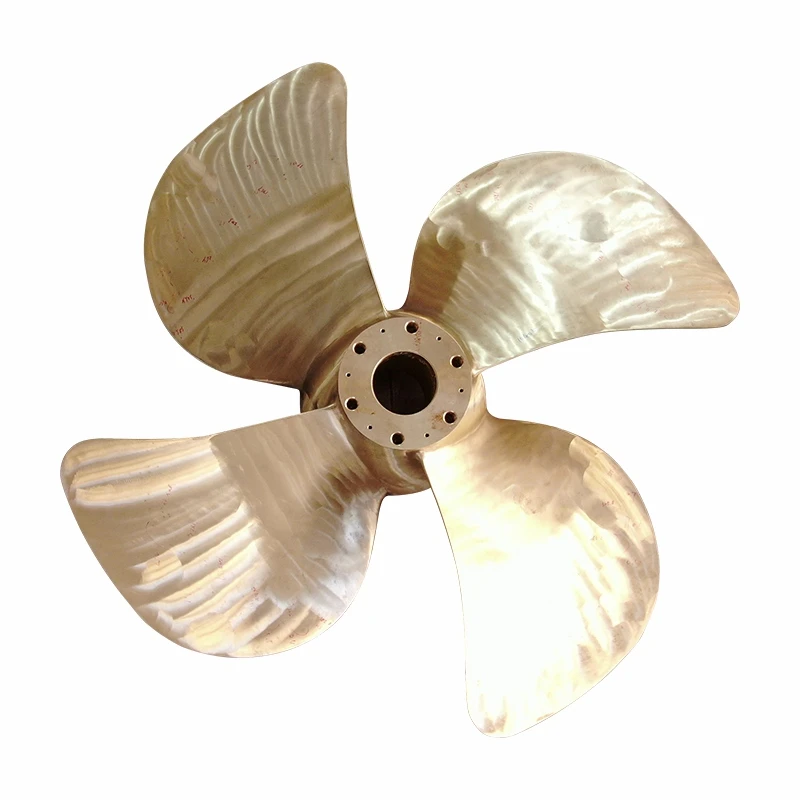


Bronze: Bronze is a traditional material used for marine propellers due to its high strength and durability. It is resistant to corrosion and wear, making it ideal for use in saltwater environments.
Stainless Steel: Stainless steel is another popular material for marine propellers. It is strong, durable, and resistant to corrosion, making it ideal for use in harsh marine environments.
Nickel-Aluminum-Bronze: Nickel-Aluminum-Bronze is a more advanced material that is designed specifically for use in marine environments. It offers excellent strength, durability, and corrosion resistance, and is often used in high-performance vessels.
Aluminum: Aluminum is a lighter material that is used for propellers in smaller boats or vessels with less demanding requirements. It is less expensive than other materials, but is also less durable and less resistant to corrosion.
Be handled carefully, using heavy gloves, body covering protection, safety glasses and safety shoes. The sharp edges of the propeller should be kept away from your body. The prop should not be stored in such a fashion that it could drop or fall upon a person. Proper wrenches and prop removal blocks are required. The engine must be placed in neutral gear and the ignition key removed, prior to prop removal or installation.
Be removed and/or properly covered (with durable safety covers) during boat or propeller transport or storage.
Be used with great caution. You should always be at idle speed and minimal rpm's whenever you are near other boats, docks, or persons.
Not be used if the operator or passengers are under the influence of drugs or alcohol.
Only be used by an alert, rested, properly trained operator.
Be inspected annually and every 100 operating hours and after every impact strike. Any damage should result in a proper repair or replacement. Propellers are subject to great stresses (as well as cavitation and impact damage) and their mechanical capabilities deteriorate over time.
FAQ
We're professional bulk carrier propeller manufacturers and suppliers in China. If you're going to buy high quality bulk carrier propeller, welcome to get quotation from our factory. Also, custom service is available.
4 M Propeller for Bulk Carrie, 5 M Propeller for Bulk Carrie, bulk carrier propeller