


Zhejiang Yuan Ding Marine Equipment Co., Ltd., with over two decades of dedicated history, has been singularly focused on one thing: crafting high-quality marine propellers. Since our inception, we have been committed to delivering exceptional Fixed Pitch Propellers (FPP) and Controllable Pitch Propellers (CPP) to meet the diverse needs of our global clientele.


Product Categories



Why Choose Us
Our Factory
With a team of 130 dedicated professionals, our 16,000 square meter workshop annually produces 2,000 tons of copper alloy propellers, committed to providing efficient and reliable marine propulsion solutions.
Custom Service
With our advanced casting process, Yuan Ding Marine delivers fully customized propellers, whether you need one unique design or consistent quality across a large batch.
24/7 Customer Support
Our round-the-clock customer support ensures quick responses to inquiries, from initial consultations to after-sales services. We're here whenever you need us.
Advantages of Yacht Propeller

Optimized for Fuel Efficiency
The propeller's hydrodynamic design reduces drag, improving fuel economy and extending the yacht's cruising range. This makes long-distance voyages more efficient and cost-effective without compromising performance.

Superior Material for Durability
Crafted from Ni-Al Bronze (nickel-aluminum bronze), the propeller is resistant to corrosion, cavitation, and wear. This material ensures long-lasting durability in harsh marine conditions, offering years of reliable performance.

Future-Ready for Hybrid and Electric Systems
The Superyacht Propeller is fully compatible with hybrid and electric propulsion systems, providing a future-proof solution for yachts embracing cleaner technologies.

●Diameter = Distance (inches /millimeters) from blade tip to the center of the propeller bore times two. Radius = 15X 2 = 30 Diameter
●Pitch =The distance (inches /millimeters) the prop would move in one rotation if it was in a solid medium.
●Blade area = Expressed as BAR, EAR or DAR all mean about the same thing. They compare the actual surface area of the propeller blades to a Full Circle with the same diameter as the prop. The propeller below has a 70% DAR.
Components of Yacht Propeller
Propeller Hub
The hub is the central part of the propeller where the blades are attached. It's designed to fit snugly onto the propeller shaft, which transmits power from the engine to the propeller itself. The hub must be precisely machined to ensure a proper fit that avoids slippage and vibration. Inside the hub, there is often a rubber or plastic sleeve that helps to absorb shock and protect the drive train by reducing the impact of sudden propeller stops (e.g., when hitting submerged debris).
Blades
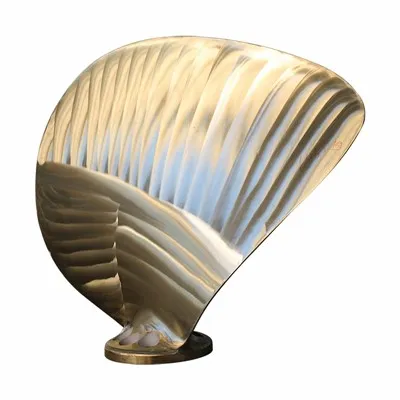
Propeller blades are perhaps the most recognisable part of the propeller system. Their design and number can vary significantly based on the specific performance needs of the yacht. Blades can be curved or straight, wide or narrow, and their shape greatly affects the efficiency and handling of the vessel.
Leading and Trailing Edges
The leading edge of a propeller blade is the edge that is adjacent to the forward end of the hub and the part that cuts into the water first. It needs to be especially tough to withstand impact and abrasion from water and any particulates or debris it encounters.
The trailing edge, conversely, is where the water exits from the blade and is crucial for the smooth flow of water, affecting the propeller's efficiency and the vibration of the propeller.
Shaft
The shaft connects the propeller to the engine. It must be strong enough to handle the enormous amount of torque from the engine and resistance from the water. Prop shafts are usually made from high-strength stainless steel or other corrosion-resistant materials because they operate in a marine environment.
Use of Yacht Propeller
Three or four blades work well in either sterndrive or outboard applications. Three-blade designs give you all-around performance with an advantage on top end speed. Four-blade designs work well with boats that are difficult to get on plane, underpowered or used in watersports where top-end speed is not critical.
Four blades in many cases will drop your rpm by 50 to 150rpm with identical pitch. Three-blade props are generally best for recreational boats with three-, four- and six-cylinder outboards and sterndrives, giving good hole shot and top-end performance.
The blades on three-blade props fill up about 50 to 55 percent of the available area inside the circle formed by the prop's diameter (referred to as the Diameter Area Ratio). Adding a fourth blade increases the DAR to between 60 and 65 percent, so you can expect more thrust to keep your boat planing at lower rpm, a potential boost in fuel economy, but also a reduction of 50–100rpm at WOT.
FAQ
We're professional yacht propeller manufacturers and suppliers in China. If you're going to buy high quality yacht propeller, welcome to get quotation from our factory. Also, custom service is available.
Superyacht Propeller, 4 M Propeller for Yacht, Yacht Prop