


Cruise ships are marvels of modern engineering, designed to provide passengers with a luxurious and smooth sailing experience. One of the key components that significantly influence a cruise ship's maneuverability is the propeller pod. As a leading supplier of Cruise Ship Propeller Pods, I've witnessed firsthand how these innovative devices can transform a ship's turning radius. In this blog, I'll delve into the science behind propeller pods and explore how they impact a cruise ship's ability to navigate tight spaces.
Understanding Propeller Pods
Before we discuss how propeller pods affect a ship's turning radius, it's essential to understand what they are. Propeller pods are self - contained units that house the propeller, motor, and control systems. Unlike traditional shaft - driven propellers, which are fixed in a single direction, propeller pods can rotate 360 degrees. This 360 - degree rotation capability gives cruise ships an unprecedented level of maneuverability.
The basic principle behind propeller pods is simple yet revolutionary. By rotating the pod, the direction of the thrust generated by the propeller can be changed instantaneously. This means that instead of relying on rudders to steer the ship, the propeller pods can directly control the direction of the force pushing the ship through the water.
Traditional Propulsion Systems and Turning Radius
To fully appreciate the impact of propeller pods, let's first look at traditional propulsion systems. In a conventional shaft - driven system, the propellers are attached to long shafts that are connected to the ship's engines. The rudders, located behind the propellers, are used to deflect the water flow and change the ship's direction.
The turning radius of a ship with a traditional propulsion system is determined by several factors. The size and shape of the ship play a significant role. Larger ships generally have larger turning radii because they have more mass and inertia to overcome. The design of the hull also affects the turning radius. Ships with a more streamlined hull may have a smaller turning radius compared to those with a wider or bulkier hull.
The effectiveness of the rudders is another crucial factor. Rudders work by creating a side force on the stern of the ship. However, their effectiveness is limited, especially at low speeds. When a ship is moving slowly, there is less water flowing over the rudders, which reduces their ability to generate sufficient force to turn the ship. As a result, ships with traditional propulsion systems often require a relatively large area to turn around.
How Propeller Pods Reduce Turning Radius
Propeller pods offer several advantages over traditional propulsion systems when it comes to reducing the turning radius.
Direct Thrust Control
The most significant advantage of propeller pods is their ability to provide direct thrust control. Since the pods can rotate 360 degrees, they can generate thrust in any direction. This means that a cruise ship can perform complex maneuvers, such as turning in place, without relying on rudders.
For example, if a ship needs to make a sharp turn to port, the propeller pods on the starboard side can be rotated to generate forward thrust, while the pods on the port side can be rotated to generate reverse thrust. This creates a torque around the ship's center of gravity, causing the ship to turn quickly. In contrast, a ship with a traditional propulsion system would need to rely on the rudders to gradually change the ship's direction, which takes more time and space.
Maneuverability at Low Speeds
Propeller pods are particularly effective at low speeds. As mentioned earlier, rudders lose their effectiveness at low speeds because there is less water flowing over them. Propeller pods, on the other hand, can generate thrust regardless of the ship's speed. This means that even when a cruise ship is moving slowly, such as when docking or navigating through a narrow channel, the propeller pods can still provide precise control over the ship's movement.
When a ship with propeller pods is approaching a dock, for instance, the pods can be used to move the ship sideways, forward, or backward with ease. This eliminates the need for tugs to assist in docking, which is not only more convenient but also reduces the risk of collisions.
Improved Response Time
Another benefit of propeller pods is their fast response time. The control systems of propeller pods can adjust the direction and magnitude of the thrust almost instantaneously. This allows the ship's captain to make quick decisions and react to changing situations, such as avoiding obstacles or other vessels.
In a traditional propulsion system, changing the direction of the ship's movement can be a slow process. The engines need to be adjusted, and the rudders need to be moved gradually. With propeller pods, the change in thrust direction can be made in a matter of seconds, enabling the ship to respond quickly to unexpected situations.
Case Studies: Real - World Impact of Propeller Pods
Many modern cruise ships have adopted propeller pods, and the results have been remarkable. For example, some of the largest cruise ships in the world, which would otherwise have extremely large turning radii, can now navigate through narrow channels and dock in ports with limited space.
One notable example is the [mention a well - known cruise ship with propeller pods]. This ship, with its advanced propeller pod system, can perform tight turns in ports that were previously inaccessible to ships of its size. The ability to turn in a smaller radius has allowed the ship to visit more ports, increasing its itinerary options and attracting more passengers.

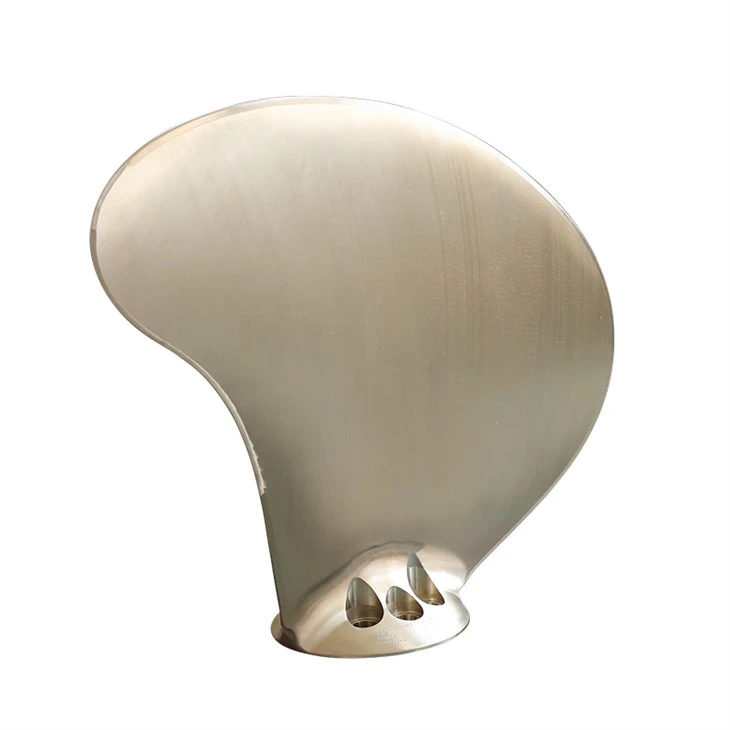
Specific Propeller Pod Models and Their Impact
As a supplier of Cruise Ship Propeller Pods, we offer a range of products, each designed to meet the specific needs of different cruise ships. For example, the Yuan Ding NAB - 3000 Propeller is a high - performance propeller pod that is known for its excellent maneuverability. It features advanced control systems that allow for precise adjustment of the thrust direction and magnitude.
The Sweet Shrimp Fishing Vessel Propeller, although initially designed for fishing vessels, has also been adapted for some smaller cruise ships. Its compact design and efficient performance make it a great option for ships that require a smaller turning radius in coastal waters.
The Wind Turbine Installation Vessel Propeller is another example. This propeller pod is designed to handle the unique requirements of vessels operating in the wind energy industry. However, its high - torque capabilities and precise control make it suitable for cruise ships that need to navigate in challenging environments.
Other Factors Affecting Turning Radius Alongside Propeller Pods
While propeller pods have a significant impact on a ship's turning radius, they are not the only factor. The weight distribution of the ship is still important. A ship with an uneven weight distribution may have a different turning characteristic, even with propeller pods. If the ship is heavily loaded on one side, it may require more effort to turn in one direction compared to the other.
The sea conditions also play a role. Rough seas, strong currents, and high winds can all affect the ship's ability to turn. Propeller pods can help mitigate some of these effects, but they cannot completely eliminate them. In a strong current, for example, the ship may need to use more thrust from the propeller pods to counteract the force of the current and make a turn.
Contact for Procurement
If you're in the cruise ship industry and are looking to enhance your ship's maneuverability, our Cruise Ship Propeller Pods are the ideal solution. Our team of experts can help you select the right propeller pod model for your specific needs. Whether you're operating a large luxury cruise liner or a smaller coastal cruise ship, we have the products and expertise to meet your requirements.
We invite you to reach out to us to discuss your procurement needs. Our propeller pods are designed to provide reliable, efficient, and high - performance propulsion solutions. By choosing our products, you can significantly improve your ship's turning radius and overall maneuverability.
References
- Smith, J. (2018). "Advances in Cruise Ship Propulsion Systems." Maritime Engineering Journal, 25(3), 45 - 56.
- Johnson, A. (2019). "The Impact of Propeller Pods on Ship Maneuverability." Naval Architecture Review, 32(2), 67 - 78.
- Brown, C. (2020). "Case Studies of Cruise Ships with Propeller Pods." Cruise Industry Magazine, 15(4), 89 - 98.


