


What is the process of manufacturing a ship propeller?
As a seasoned supplier in the ship propeller industry, I'm thrilled to take you on a journey through the intricate process of manufacturing these essential marine components. Ship propellers are not just simple blades; they are the result of meticulous engineering, advanced technology, and a deep understanding of hydrodynamics.
Design Phase
The manufacturing process of a ship propeller begins long before any metal is cut. It starts with the design phase, where a team of experienced naval architects and engineers come together. They analyze various factors such as the type of vessel, its intended speed, power requirements, and the operating conditions. For example, a Sweet Shrimp Fishing Vessel Propeller will have different design specifications compared to a large cruise ship propeller.
Using sophisticated computer - aided design (CAD) software, they create a virtual model of the propeller. This model allows them to simulate the propeller's performance under different scenarios, optimizing its shape, size, and blade profile. The number of blades, their pitch, and the diameter of the propeller are all carefully calculated to ensure maximum efficiency and minimal vibration.
Once the initial design is complete, it undergoes a series of rigorous tests. Computational fluid dynamics (CFD) analysis is used to study the flow of water around the propeller blades. This helps in identifying any areas where the design can be further improved to reduce cavitation, a phenomenon that can cause damage to the propeller and reduce its efficiency.
Material Selection
After the design is finalized, the next crucial step is material selection. The choice of material depends on several factors, including the size of the propeller, the operating environment, and the vessel's requirements. For most ship propellers, high - strength bronze alloys are commonly used. These alloys offer excellent corrosion resistance, good mechanical properties, and can withstand the harsh marine environment.
In some cases, stainless steel may be used, especially for smaller propellers or in applications where weight is a concern. The material is carefully inspected to ensure it meets the required quality standards. Chemical composition analysis and mechanical property testing are carried out to verify its suitability for the propeller manufacturing process.
Pattern Making
Once the material is selected, a pattern is created. The pattern is a replica of the propeller and is used to make the mold for casting. Traditionally, patterns were made from wood, but nowadays, more advanced materials such as plastic or resin are often used. These materials are more durable, accurate, and can be easily modified if needed.
The pattern is made with great precision, following the exact dimensions of the designed propeller. It includes all the details of the blade shape, the hub, and any other features. The pattern - making process requires skilled craftsmen who have a deep understanding of the propeller design and the casting process.
Mold Making
With the pattern ready, the next step is mold making. There are different methods for making molds, but the most common one for ship propellers is the sand - casting method. In this method, the pattern is placed in a box filled with special sand. The sand is compacted around the pattern, creating a cavity in the shape of the propeller.
The mold is then carefully removed from the pattern, and any necessary cores are inserted to create internal features such as the hub bore. The mold is designed in such a way that it can withstand the high temperatures and pressures during the casting process. It is also important to ensure proper venting to allow the escape of gases during casting.
Casting
Casting is one of the most critical steps in the propeller manufacturing process. The selected alloy is melted in a furnace at a high temperature. Once the alloy reaches the proper melting point, it is carefully poured into the mold. The pouring process must be done slowly and evenly to avoid any air bubbles or defects in the casting.
During the casting process, the molten metal fills the mold cavity, taking the shape of the propeller. As the metal cools and solidifies, it forms the basic structure of the propeller. The cooling rate is carefully controlled to ensure proper grain structure and mechanical properties.
After the casting has cooled down sufficiently, it is removed from the mold. The casting is then inspected for any visible defects such as cracks, porosity, or incomplete filling. Non - destructive testing methods such as ultrasonic testing and X - ray inspection are often used to detect internal defects.
Machining
Once the casting has passed the inspection, it is ready for machining. Machining is the process of removing excess material from the casting to achieve the final dimensions and surface finish. The propeller is mounted on a large machining center, where a series of cutting tools are used to shape the blades, the hub, and other parts.

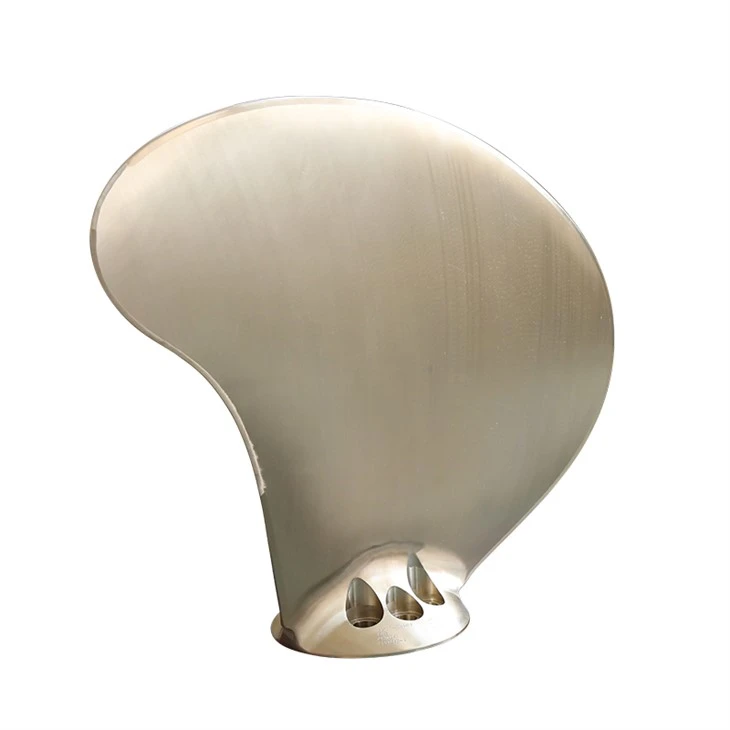
The machining process is highly precise, with tolerances measured in thousandths of an inch. Computer - controlled machining centers ensure accurate and consistent results. The blades are machined to the exact pitch and profile specified in the design, and the hub is bored to the correct diameter.
Surface finishing is also an important part of the machining process. The propeller blades are polished to a smooth finish to reduce friction and improve efficiency. This helps in reducing the power required to turn the propeller and can also enhance the vessel's speed.
Balancing
After machining, the propeller undergoes a balancing process. An unbalanced propeller can cause excessive vibration, which can lead to damage to the vessel's propulsion system and reduce its comfort level for passengers and crew. Balancing involves adding or removing small amounts of material from the propeller blades to ensure that the center of mass is located at the center of rotation.
Specialized balancing equipment is used to measure the imbalance and determine the exact location and amount of material to be removed or added. The propeller is rotated at high speeds, and sensors detect any vibrations. Based on the readings, the necessary adjustments are made until the propeller is properly balanced.
Quality Control
Throughout the entire manufacturing process, quality control is of utmost importance. Every step, from design to the final product, is closely monitored to ensure that the propeller meets the highest quality standards. In addition to the tests mentioned earlier, final inspection is carried out before the propeller is shipped to the customer.
Dimensional inspection is done using precision measuring tools to verify that the propeller meets the design specifications. The surface finish is also inspected to ensure it is smooth and free from any defects. The propeller is also tested for its mechanical properties, and a final performance test may be carried out to ensure it operates as expected.
Assembly and Testing
Once the propeller has passed all the quality control tests, it is ready for assembly. If the propeller is a controllable - pitch propeller, the necessary components for adjusting the blade pitch are installed. The propeller is then mounted on a test bench, where it is connected to a motor and a dynamometer.
The test bench allows for the simulation of real - world operating conditions. The propeller is run at different speeds and loads, and its performance is measured. Torque, power consumption, and thrust are all recorded to ensure that the propeller meets the design requirements. Any issues or discrepancies are identified and corrected before the propeller is delivered to the customer.
Delivery and Installation
After successful testing, the propeller is carefully packaged and prepared for delivery. It is important to ensure that the propeller is protected during transportation to prevent any damage. Once it reaches the customer's location, it is installed on the vessel.
Installation of a ship propeller is a complex process that requires specialized equipment and skilled technicians. The propeller must be properly aligned with the shaft to ensure smooth operation. After installation, a final check is carried out to ensure that everything is in place and the propeller is ready to be used.
As a Ship Propeller supplier, we understand the importance of providing high - quality propellers that meet the diverse needs of our customers. Whether you are in need of a Sweet Shrimp Fishing Vessel Propeller, a Motor Carrier Propeller, or a Car Carrier Propeller, we have the expertise and experience to deliver a product that meets your expectations.
If you are interested in learning more about our ship propellers or would like to discuss your specific requirements, we invite you to contact us for a procurement discussion. Our team of experts is ready to assist you in finding the perfect propeller solution for your vessel.
References
- "Marine Propellers and Propulsion" by J. Carlton
- "Ship Design and Construction" by S. Bhattacharyya
- Various industry - specific research papers on ship propeller design and manufacturing.


